Most hiring is still decided in the same way it was thirty years ago: on instinct. Here’s why that’s the most expensive habit in your business and what a real process looks like.
“I just had a good feeling about her.”
Every leader who has ever made a hire has said a version of that sentence. And every leader who has ever made a bad hire has said it too.
That’s the problem. Gut feel is the one thing in your hiring process that has nothing to do with whether someone will actually do the job well. We’ve built an entire industry on the assumption that experienced people can read talent in a 45-minute conversation. The evidence says otherwise.
A major meta-analysis found that structured hiring processes are twice as effective at predicting whether someone will actually perform well in a role. Not slightly better. More than twice. And yet many organisations still rely on conversation formats with no set criteria, no scoring, and no agreed definition of what ‘good’ even looks like.
That’s the gut-feel tax. And companies are paying it every quarter.
The bias hiding in plain sight
There is a second cost to unstructured hiring that rarely appears on a balance sheet: discrimination risk. When there are no agreed criteria, no scoring rubric and no structured process to hold interviewers accountable, unconscious bias fills the gap.
And the real-world fallout is serious. US employment discrimination filings hit a record high in 2024, with almost $700 million recovered by claimants in a single year.
A 2024 study by economists at UC Berkeley and University of Chicago sent 83,000 fake job applications to Fortune 500 employers. It found that white applicants received 9% more call backs than equally qualified Black applicants.
The legal and reputational exposure of gut-feel hiring is not hypothetical. It is being measured, litigated and reported on a scale that makes a structured process a commercial necessity, not just a best practice.
What “structured” actually means (and what most people get wrong)
When people hear “structured hiring,” they think of a longer interview script or a Google Form scorecard. That isn’t structure. That’s paperwork.
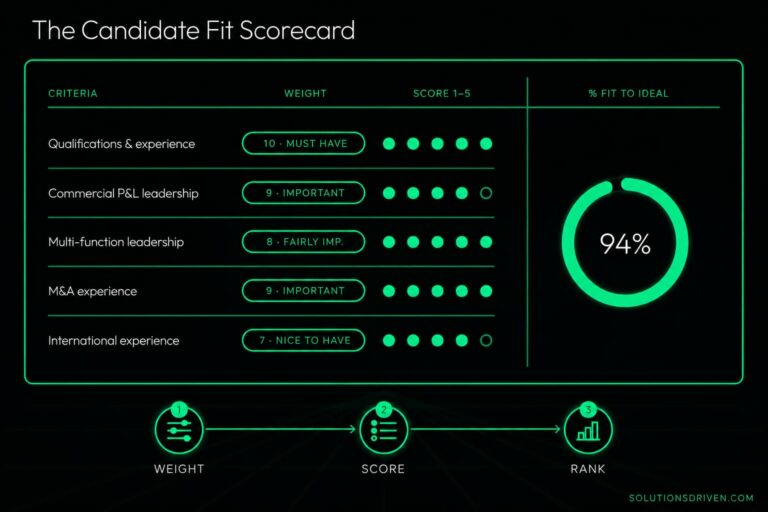
A structured process means every part of the hire is defined before you start. Not just the questions. The criteria. The weighting. The bar. The fit dimensions. The decision-making rules. Who gets a vote and what their vote is measured against. Everyone evaluating the candidate is doing it against the same standard, not their own preferences.
This is the difference between “she interviewed well” and “she scored 8.5 against a weighted scorecard built around the six competencies we agreed mattered for this role.” One of those is defensible. The other is a feeling dressed up as a decision.
Structure also extends to what happens before and after the interview. Is the scorecard built before a single CV is reviewed? Are hiring managers aligned on the non-negotiables before sourcing begins? Are the fit dimensions defined, not assumed? In most organisations, the honest answer to all three questions is no.
The price of getting it wrong
Getting the right fit for an executive role is critical. The financial stakes are high. According to research by the Center for American Progress, replacing a highly specialised or senior leader can cost up to 213% of their annual salary. When you fold in the hidden costs – productivity loss, team disruption and the time required to rerun the search, the full financial impact of a single bad executive hire can be staggering.
And no amount of “we have great instincts” fixes it. The organisations still hiring on a feeling aren’t just at risk of a bad hire. They’re falling behind every competitor who has built a proper process.
Quality of hire as a defining metric
LinkedIn’s Future of Recruiting 2025 report found that 89% of talent professionals agree measuring quality of hire is becoming increasingly important, overtaking speed and cost as the defining measure of recruiting success. That tells you something. The industry is finally asking “did this person actually work out?” instead of just “how fast did we fill the seat?”
Quality of hire cannot be improved by posting on more job boards or shortlisting faster. It can only be improved by building a process that reliably distinguishes between candidates who will perform and those who simply present well. That is a structural problem and it requires a structural answer.
Why Solutions Driven built an operating system, not a process
At Solutions Driven, we don’t run a recruitment process. We run a Hiring Operating System. The distinction matters.
A process is a set of steps. An operating system is a framework that holds itself accountable, regardless of who is running it, what the role is or which country it sits in. It removes the variation that makes hiring feel like a lottery.
Two parts of that system replace the gut-feel layer entirely.
6S is our six-stage search process. Scoping, Scorecarding, Sourcing, Selecting, Securing, Satisfying. Every search starts with stakeholder alignment and a weighted scorecard built before we look at a single CV. We don’t send you a stack of candidates. We send you the three to five who score above an agreed bar, with the evidence to back it up. Each stage is defined, each output is measurable and the criteria that determine a shortlist are set by data and agreement, not by instinct. When the scorecard is built first, every downstream decision becomes faster and more defensible.
6F is our fit methodology. Six dimensions we assess in parallel with the technical screen: Fit, Freedom, Family, Fulfilment, Fortune, Future. These are the factors that quietly sink hires three months in. Misaligned autonomy expectations. Unspoken compensation gaps. Career ambitions that don’t match the role’s trajectory. Cultural disconnects that never surfaced in the interview but emerge the moment onboarding is over. We have the difficult conversations early, so you aren’t blindsided at offer stage or, worse, three months into a placement.
Most placements don’t fail because the candidate couldn’t do the job. They fail because nobody asked the right questions before the offer was signed.
What changes when you remove the guesswork
Solutions Driven has run this system across 60-plus countries for 25-plus years. 97% of our clients hire from the first shortlist we deliver. We back every placement with a 12 to 18 month guarantee, longer than any competitor will sign up to, because when the process is right, the outcome is predictable.
The leaders we work with are not less talented than those at organisations with a poor hiring track record. They simply had a process that rewarded confidence and penalised scrutiny. When you replace instinct with infrastructure, the whole picture changes. Decision-making becomes faster because the criteria are already agreed. Shortlists become smaller because the bar is clearly defined. And offers become stickier because fit has been assessed properly, not assumed.
Ready to see what a structured hire actually looks like?
Book a conversation. We’ll walk you through how the operating system applies to a role you’re trying to fill and what your current process is leaving on the table.