
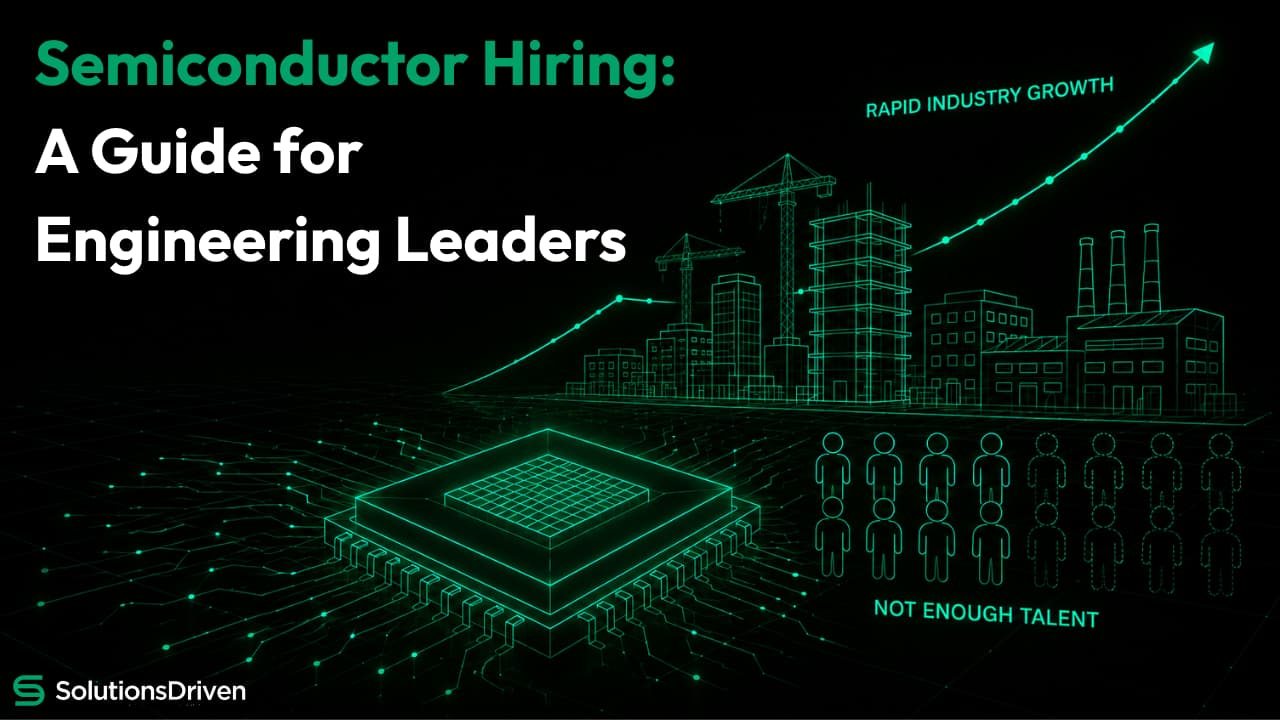
Semiconductor hiring has not kept pace with the industry as it grows faster than at any point in its history. The shortfall is sharpest in the mid-senior leadership roles that keep a chip plant or a design programme on schedule.
Global chip sales are on track to pass $1.5 trillion in 2026. Demand from artificial intelligence infrastructure, high-bandwidth memory, and accelerated computing has carried the market past the trillion-dollar mark most forecasters had pencilled in for 2030, roughly four years ahead of schedule.
The workforce plan was built for the slower curve. Deloitte estimates the industry needs more than one million additional skilled workers globally. Fabs, short for fabrication facilities, are now being announced faster than the people who run them can be trained. That is the shape of the semiconductor talent shortage: capacity arriving ahead of the people to run it.
Capacity can be funded. Experience at advanced nodes cannot be bought in a quarter, which is why a growth cycle moving at this speed exposes the top of the organisation first.
This guide sets out where the pressure is concentrated, why the usual hiring strategies do not always apply to this industry, and how to hire mid-senior semiconductor leaders in a market where the strongest candidates increasingly have the pick of who they work for.
Why is semiconductor hiring so hard right now?
Demand for chips is rising fast across artificial intelligence, automotive, and industrial applications. The pipeline of experienced leadership has not grown with it.
The result is a market where senior roles sit on what engineering leaders call the critical path. That is the chain of work which sets the length of the whole programme, so anything that slips on it delays everything behind it. If a verification lead, a yield lead, or a fab operations director is missing, tapeouts slip, yield ramps stall, and customer deliveries move.
That turns a single vacancy into a business risk rather than a scheduling inconvenience, which is precisely why these hires need a different approach from routine engineering recruitment.
The scale of the gap is well documented. SEMI’s analysis of the workforce put the leadership shortfall in surprising numbers: the industry will need at least 100,000 second-line leaders and 10,000 third-line leaders by 2030. Those are the managers who run teams of managers, and the leaders above them again. Many will have to come from outside the semiconductor sector altogether.
None of this sits in the future. It is already shaping how long searches take and how much senior talent costs.

Which senior semiconductor roles are hardest to fill?
The hardest semiconductor roles to fill are the ones where deep technical depth meets scarce senior experience at advanced nodes.
Design and verification leadership is the clearest example. Verification managers, DFT leads, and physical design leads with real leadership experience at 5 nanometres and below are in short supply, for the straightforward reason that comparatively few leaders have ever worked at that level. The pool is small before anyone starts competing over it.
Leadership across mixed-signal, power, and RF disciplines is just as difficult to secure, and for a different reason. Those disciplines rely on judgement built over years of silicon iterations rather than on tool proficiency, so that experience cannot be shortened or trained into someone quickly.
At the top of the structure, the shortage of engineering directors, VPs of fab operations, and second- and third-line leaders for design organisations and fabs is a genuinely global problem, not a regional one.
Compensation reflects this scarcity. Senior engineering managers across process, manufacturing, electrical, and chemical disciplines now sit at the upper end of engineering pay scales. Fab and site executive packages, particularly where equity is involved, run well into six figures in most major markets.
Why does the usual hiring approach vary here?
The usual approach fails because it was built for a market with more candidates than roles. Senior semiconductor hiring is the reverse, and a semiconductor recruitment strategy designed for volume will not close these roles.
Job specifications are often too narrow and too rigid. A candidate who matches 70% of the requirement gets rejected over a missing tool or process detail, even while the role stays open for months.
Location makes this worse. Senior semiconductor roles are tied to specific fab clusters, meaning the handful of regions where fabs and their suppliers are concentrated. Visa rules and limited relocation budgets then shut out exactly the global talent pool that a genuine shortage should force companies to open up.
The overwhelming majority of mid-senior leaders in established hubs are already employed, often held in place by long tenure and by unvested equity, which is share awards they forfeit if they leave before a set date. They do not respond to a generic job advertisement. Reaching them takes direct, relationship-led outreach rather than a posting and a hope.
Internal process works against speed too. Senior semiconductor hires routinely take months longer to close than comparable engineering hires, and stacked technical assessments and multiple rounds of stakeholder interviews give faster-moving competitors the chance to make an offer first.
Read Our Semiconductor Hiring Intelligence Report
Click through the headings on the left panel to see the depth of information we gathered on this market for a client. This report provides all of the data you would need to start a new search.
Read nowHow to win mid-senior semiconductor leaders: five strategies that close these roles
1. Define the critical path role, ruthlessly
Separate must-have skills from nice-to-have before the search opens, and tie each requirement to a specific business outcome, such as unblocking timing closure at 5 nanometres or reducing yield excursion risk, both of which cost real money when they go wrong. Naming the outcome gives HR a clear basis for prioritising candidates, and it stops strong candidates being filtered out over minor tooling differences.
2. Align compensation and equity with real scarcity
Mid-senior leaders in shortage clusters expect above-market total compensation, and equity is usually part of the deal. Those clusters include verification, lithography, AI chip architecture, and process integration, the discipline that makes hundreds of individual manufacturing steps work together as one reliable process. Benchmark against current scarcity rather than legacy pay scales.
3. Build a value proposition beyond salary
Career development and flexibility are consistently cited as reasons mid-senior leaders leave a role or avoid one, so make advancement and technical ownership explicit rather than assumed. Candidates at this level can choose between industries, so lead with the strategic impact of the role rather than a list of tasks.
4. Use specialist search and direct outreach
Most mid-senior leaders in the key hubs are passive and retained by equity, so a semiconductor recruitment strategy built around job advertising will not reach them. A specialist search partner who can map niche skill clusters and approach those leaders directly will consistently outperform a posting. The approach itself has to cover compensation, equity replacement, and career trajectory together rather than one at a time.
5. Fix the internal process before it costs you the candidate
Simplify interview loops, bundle technical assessments where possible, and give hiring managers the authority to move fast once a senior candidate is identified. It is also worth revisiting overly strict node-specific or tool-specific filters. Much of the shortage is about applied, fab-relevant skill rather than a lack of engineers altogether, and structured upskilling can close some of that gap internally.
Where Solutions Driven fits in
We work on the roles that sit on the critical path: the verification leads, fab operations directors, and site executives that a semiconductor programme cannot afford to leave open.
Our Industrial & Engineering specialists run the Hiring Operating System end to end through the 6S process, from scoping the role against real business outcomes through to securing and satisfying the hire once they are in seat. That structure is why 97% of our placements are the right hire, first time, and why we offer a 12-18 month replacement guarantees depending on the seniority of the role.
If your semiconductor hiring has stalled, or you keep losing strong candidates to faster-moving competitors, talk to our team about how a structured search closes these roles faster.
Frequently asked questions
Which semiconductor roles are hardest to fill?
Senior verification and physical design leaders working at advanced nodes, leadership across mixed-signal and RF disciplines, process and yield leaders, and executive-level fab and design leadership are consistently the hardest roles to close.
How to hire mid-senior semiconductor leaders who are not actively looking?
Most mid-senior leaders in the established hubs are employed and held in place by unvested equity, so they respond to direct, relationship-led approaches rather than advertising. The approach has to address compensation, equity replacement, and career trajectory together. It works best when a specialist partner has already mapped the relevant skill cluster.
Can upskilling reduce the semiconductor hiring talent shortage?
Only partially, since much of the shortage is about applied, fab-relevant experience rather than a straightforward lack of engineers, so structured upskilling and less rigid node-specific filters can widen the usable candidate pool.
Why do senior semiconductor searches take so long?
Most senior candidates are already employed and not actively looking, job specifications are often too rigid, and internal interview processes tend to be longer and more stacked than in other sectors. Together those push search timelines well beyond those in comparable engineering fields.